
Since launching the CommonsDB Explorer late last year and moving the prototype registry into active testing, we have focused on scaling up the volume of registry declarations. The registry has now surpassed one million declarations, thanks to the contributions of our project partners, the Europeana Foundation and Wikimedia Sverige.
A Foundation for Transparent Rights Information
The goal of CommonsDB is to create a reliable and accessible infrastructure for identifying and verifying the rights status of digital content. Our metadata model and trust architecture ensure that whether a machine or a human queries the registry about a work, the returned declaration data is clear, consistent, and securely linked to a verified identity. This allows anyone to independently check who has contributed rights information about specific works.
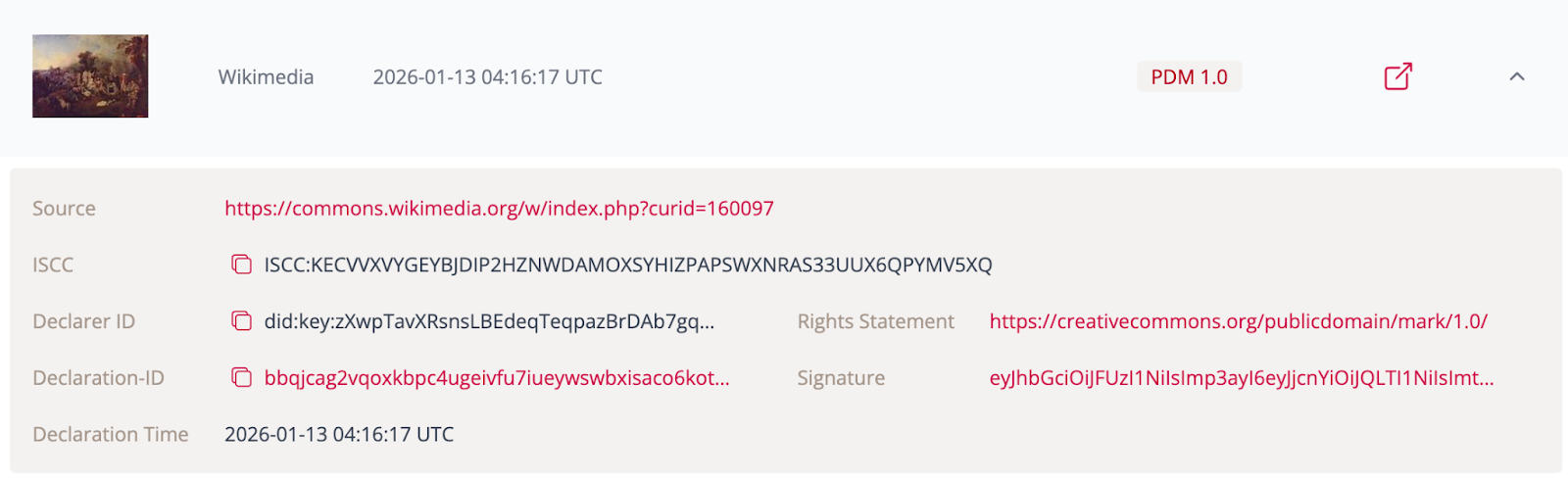
What's in a Declaration?
Every CommonsDB declaration consists of structured, machine-verifiable metadata. Submitted via our Declaration API, the information is grouped into three key areas:
- The Work: This section identifies and describes the asset being registered. It uses a content-derived identifier (ISCC) to bind the declaration to the digital file. Mandatory fields include the title of the work and a URL pointing to the item at the Data Supplier's repository, while optional fields support registration of the work’s creator, institutional steward, and a description.
- Rights Information and Provenance: This section establishes the legal status and the authority of the claim. It requires a machine-readable rights statement (such as a Creative Commons license). Crucially, it also includes the required Verifiable Credentials and the Decentralized Identifier (DID) of the Data Supplier. Backed by our multi-layered trust architecture, these credentials provide a cryptographically verifiable link to the entity making the claim, ensuring provenance and accountability.
- Cryptographic Proofs: Each submission is digitally signed by the verified data supplier using private keys tied to their credentials, preventing any tampering. This setup, complete with a JSON Web Token (JWT) signature and a Timestamp Authority (TSA) signature, ensures data integrity and provides a machine-verifiable record of when the declaration was logged, strictly validated against the server time.
What's Next
By scaling up CommonsDB to millions of declarations, we want to demonstrate that registry technology can foster the trust and transparency needed for users to legally reuse and remix works within the digital commons.
Reaching one million declarations is an important milestone for the prototype, but we’re going further—our target is five million declarations by summer 2026. In the coming months, we will continue testing and refining the registry, and focus on onboarding new Data Suppliers to broaden the diversity of our data. To support Data Suppliers with integration, we will publish online resources documenting best practices for ISCC generation, rights modeling, and declaration submissions to CommonsDB.
We invite you to browse the expanded dataset in the CommonsDB Explorer. If your institution is interested in participating as a Data Supplier, please get in touch by email.